


4,204 words.
For all the pomp and opulence of the empire, it was as rotten at its core as any other. The swordsmith sees this clearly in the weapons he forges. He is a master of his trade, with a century of experience, forging weapons worthy of the warrior kings of old, only for them to end up a simple decoration for a belt or used on an unlucky peasant’s neck. A cruel joke of life’s.
But maybe, it was all a preparation.
The smith had just returned from delivering a sword to a friend of the local governor’s son—a useless waste of air, too spoiled to be strong, and too young to be wise—when the smithy’s door is whisked open and a stranger steps inside.
The man is as pale as overheated iron and dressed in a long black cavalry jacket. Neither the stranger, nor his clothes make a sound as he moves, he merely mutters a handful of whispers in a tongue the smith doesn’t understand. When the door swings shut, the stranger stops whispering and turns to face the smith. He is a young half-elf with raven black hair and bright gray eyes that seems to see beyond the room itself. He looks the smith up and down with these eyes and the smith, a dwarf who’s seen many a year, many a fight, and been eye to eye with a handful of kings, flinches.
After a moment, the stranger greets him by name and sets a piece of paper on the smith’s anvil.
The smith glances at it and sees an order with great complexity. This man is no noble, and no soldier. There is an air about him that the smith distrusts, so he names a price higher than usual. The stranger’s face stays unmoving, but he tilts his head to the side and asks the smith to look closer at his request.
Suspicious, the smith picks up the paper, thinking maybe this man thinks the high price unreasonable.
However, what is on the page makes him pause.
This sword he has requested is one that will see use, see blood. The smith can see it in how it leaves out gold and gems, the way the man requested the taper of the blade’s edges, the lengthy list of magic woven throughout its core.
The blade is to be made of thin blacksteel. Less flashy than standard steel, but stronger, keeps a better edge, and with the right magic, is practically invisible in the dark. The material of an assassin’s blade, but this is one longer than any assassin would want.
The smith almost questions it, but holds off, moving on to examine the wards and the runes. As he keeps reading, he begins to wonder if the stranger wrote this in his own hand, for it is a flowery script fit for a court scribe. Now, the smith is used to seeing the writ of scribes, but that is because the scribes themselves usually deliver the orders.
Regardless, the runes. Their binding processes are overly described, and the smith finds himself mildly insulted that this man thought he was such a common worker that he doesn’t understand his own trade. Then, he realizes, as he reads further, that the man’s specificity is warranted; no one has ever requested a weapon such as this in all his years.
There are the simple magics of course: A binding rune in the hilt to make the weapon difficult to drop or hard to disarm. A longevity ward in the blade so that it maintains its edge. A strengthening ward on top of the blacksteel to ensure it is nigh unbreakable. The concealing magic that makes blacksteel infamous.
Difficult magic, for a lot of smiths.
All basic for his capabilities.
Though that does not stop him from charging a fortune. No, these runes he has put in a dozen swords. It is the few that follow them that make him pause, make him realize the momentous task ahead of him, and why this stranger had him look closer.
The first is a modification of a recall spell. An enchantment to bring the sword to the wielder’s hand should the wielder say the proper incantation. A simple process. Not an easy one. With these notes, the smith believes he should be able to do it.
The second is a weight rune. Mostly used for assassin’s daggers, or other thrown weapons. A rune that lightens the weapon in the hand, and makes it fly straighter. The smith has never used this rune on a long blade. Again, a challenge, though he does not believe it shall be hard.
The third will let the wielder call ghostflame to the blade. A fire that neither water, nor magic, can extinguish. The smith has done this once before, merely to see if he could. That sword is the one he himself carries.
The fourth is odd, for it affects the wielder, not the sword itself. It lightens the body, like the spells wizards use to fall slower. In a fight, this would make the wielder able to move in unexpected ways. The smith smiles to himself; this is a good idea for a weapon of his own, should he ever need another.
And finally, the fifth and last rune. A magic he has never seen before and one he barely understands. It is in the core of the sword, and it requires a flaw in the metal. A flaw that would make the sword unusable for combat. A flaw that would make it nearly guaranteed to shatter, in spite of all of the magic already channeled through it. The smith’s smile fades and he raises his head to squint at the stranger, who merely gestures back at the page.
Reading the last pieces of the process, the smith realizes he is looking at a rune he thought lost to the annals of time. A blasphemous rune that enables the sword to be wielded by the incorporeal. A blade that has only existed in legends nearly forgotten by all. The legends of the spirit kings.
A tale thought to be entirely fantastical.
Purely a cautionary fable.
But it would seem legends always hold some truth, even the unexpected ones.
The legends were so ancient, so far-fetched, that no known smith in the modern day would consider trying to rediscover or recreate this rune. None would consider it even possible. How this stranger discovered the process once more, the smith does not know. He also realizes he does not particularly want to know either.
What he does know is that to forge this sword would be blasphemy and treason. A weapon wieldable by spirits is one of the very few he swore he would never forge. Though, the smith does remind himself he only swore that because he had to, to be called a smith.
Regardless, he considers turning the stranger away. Considers refusing the work. If he was caught, he would be thrown out of the city, if he was lucky. Losing everything, he’d be barred from smithy work in the entire empire. Forced to flee overseas should he ever wish to forge again. A massive risk.
But, when he looks into the half-elf’s eyes, he sees his own question reflected back at himself. Almost a challenge.
The smith makes up his mind: he will do it. This weapon will take every skill he has ever learned and require him to go against old habits to forge a weapon worthy of his name. Finally, he will be stretched to his limit. A task which he has been waiting for his entire life.
How could he turn it away?
He names a price higher than he’s ever charged, and the stranger nods.
With a crooked grin, the smith reaches out for the stranger’s hand. As they shake, he memorizes the size of the half-elf’s palm, and the length of his fingers. The weapon requested is a hand and a half sword; now the smith knows the proper dimensions.
The smith has everything he needs but the due date. The stranger leaves before he remembers to ask.
When he does remember, he checks the paper. It’s not included, so the smith decides it is not his problem.
He thinks no more on this matter.
Lumbering back to his metal storage, the smith takes a long time to sort through his blacksteel. Most is unsatisfactory. Or rather, unsatisfactory for a blade such as this. But, after nearly an hour, he finds enough for two swords.
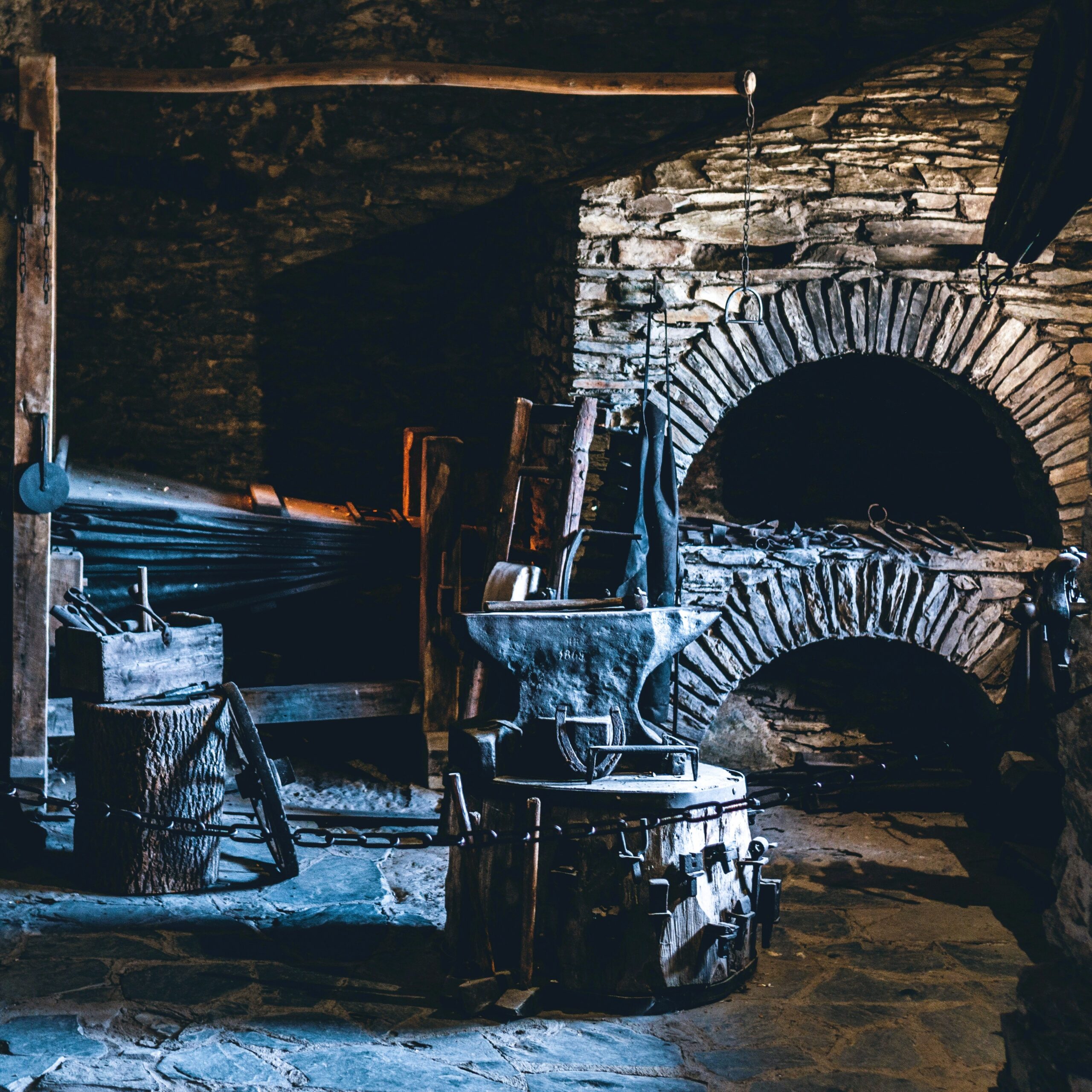
Returning to the main room, the smith sets half of the metal aside. A quick muttering and he throws a spark into the forge. It roars to life, sending out the acrid smell of magefire that tries to burn nerves long desensitized. The smith tosses the blacksteel into the fire and as it heats, he selects the hammer he wants to use alongside a pair of tongs.
The magefire heats the metal fast and it isn’t long before the smith fishes it out. Setting it on his anvil, he brings his hammer down on it, hard. Sparks fly, and he slams his hammer down on it again. The smith’s strikes reverberate through his arms, shoulders, back. The muscles contracting, and relaxing. A steady beat that he lets himself get lost in. The metal moves with each strike. Imperceptible to the average eye, but obvious to the smith’s enchanted sight.
Slowly, the blacksteel cools, and back into the fire it goes. It heats once more and the steady beat begins again.
It takes him hours and a dozen reheats to draw out the blade. Blacksteel doesn’t like to move, but the smith is more stubborn than the metal.
When he finally has something resembling a sword, the smithy is lit by only the forge’s fire.
Carefully, with the patience and meticulousness of the seasoned smith he is, the dwarf enhances his eyes further with a muttered phrase and examines his work.
The blade is solid, straight, perfect, flawless, and he sets it aside. It will make a good blade for a lesser man.
He begins anew.
The second piece of blacksteel goes into the fire and warms. His arms are tired and his hammer is heavier than when he started, but he does not stop. There is proper work to be done. For once.
He grabs the metal and places it on his anvil.
He strikes it again and again. The metal moves, slowly, but surely. Stretching outward, flattening, lengthening, cooling, and back into the fire.
The smith grabs a towel and wipes the sweat from his brow, his arms. Soon, the metal is ready to work again and back to the anvil it goes. Again and again, the process repeats.
By the time the blade has begun to take shape, the first rays of sun are shining into the forge. It is another few hours still when the smith stops to examine his work.
The blade is solid with the slightest of twists. The core is strong, flawless, and he sets it aside. Again, it will make a good blade for a different wielder.
It is nearly midday. The fire in the forge is sputtering down. The smith is tired, his muscles are starting to protest. It has been years since he has worked through the night. Years since he has put this much effort into a project and he is finally able to notice his age. He needs to rest, needs to get a proper meal.
He needs more blacksteel.
Ignoring the complaints of his flesh, he returns to his storage to search through it once more. As he picks over pieces, something scratches at the back of his mind, something seems off that he can’t quite put his finger on, then he sees it. A piece of blacksteel sitting out of the pile, off to the side. An unsightly, twisted hunk that he doesn’t remember where it came from, or how many years it’s been here.
He shoves steel out of his way and grabs it, examines it. There are cracks, facets, flakings, this metal is beyond terrible.
It will do.
He takes it back to the forge.
Again, he starts. Again, the blade begins to take shape. Again, he watches for a flaw.
And watches one form, perfectly.
It goes against a century of experience to continue this blade, but continue it he does, a smile creasing his weathered face.
His hammer falls again and again on the unfinished steel. Ringing out loud and clear in the forge. As he loses himself in the pattern, he begins to weave the magic into the core. Binding it to the flaw, filling it with a ghastly energy just like the stranger’s notes say.
Slowly but surely, the rune takes root. Weaving from the flaw, through the entirety of the metal. Filling the flaw, strengthening it, binding it all together as if the flaw did not exist. When it is finished, so is the blank.
It is here that the smith finally decides to get a meal and some rest. The magic he just wove through the metal drained the last of the energy his body had, it would be foolhardy to push onward. He would only run the risk of damaging his work.
So, he rests.
But not for long.
The sun is not yet setting when the smith sets foot back in his forge. The first part of the work is complete. Now comes the work that cannot be completed with a hammer.
Turning away from his anvil, he mutters another spell and his grinding wheel begins to spin. Against the wheel the unfinished blade goes and sparks fly. Slowly, gradually, the blade takes a finer shape, a proper shape.
The hours pass and the sun sets. Still, the smith continues. He’s more careful with this than he would be normally. The magic already within the blade is foreign to him. He thinks it’s best not to anger it.
When he gets the blade to the shape he desired, he takes it to another room. Usually, his apprentice would fit the handle, the guard, the pommel, but not for this one. It is good fortune the boy is off on a delivery. The smith wouldn’t want to explain this to the curious lad.
The guard and pommel are to be silver wolfsteel, the handle hydrahide wrapped rhinoceros bone. Blacksteel needs only to be normalized once, and wolfsteel shares this quality so the smith often pairs these two. Usually it is for convenience’s sake, today it is for function. Wolfsteel can match or surpass blacksteel’s durability. This sword will last.
It does not take the smith long to find the materials. It takes him a little longer to figure out how much he needs.
The guard is simple; the stranger wanted it to be practical, not flashy. The pommel is the same and will not take much effort. Both will be simple to forge; both will be done later. It is fitting the rhinoceros bone that takes the smith a long while.
He’s not inexperienced in handle making, simply out of practice. It takes him two tries to get the rhinoceros bone fitted the way he wants it. Two tries that took two hours.
He sets the handle pieces aside and returns to the forge. Back into the magefire the blade goes. As it heats, he rubs his neck. His muscles are tight, almost painfully so. His face is red, his skin raw, the forge is filled with the stench of heated metal, and the fire’s been keeping the air hot.
There’s spells to dampen how it affects the body. Spells to stop the heat, protect one’s skin, keep the acrid smell from burning one’s eyes and nose.
He’s never cared, the discomfort makes him feel alive.
The work runs in his blood.
To do any different would be denying his nature.
The blade is heated soon, and he fishes it out again. Hanging it in the center of the room, he calls magic to his hands. With precise incanting, he weaves the beginning of a spell through the metal and leaves it. As it cools, the magic will continue to mature until the longevity ward is complete and the blade is normalized.
He returns to the other room now, to retrieve the wolfsteel that he set aside for the guard and pommel. While the blade cools, it is time to give one of them form.
Into the fire the guard goes, and the smith selects a finer hammer than the one he was using. When it heats, out it comes and his work continues.
Wolfsteel moves easier than blacksteel, so the smith takes more care of his strikes. Gently drawing the piece out, he thins it out, forms the hole for the sword, then gives it a slight curve forward. Enough to give more motion to the wrist, not enough to trap a sword.
The guard’s shape is simple and soon done. The weight rune is next and it is familiar magic. The smith’s hands glow bright, then fade out as he channels magic into the guard. One small modification to it since it is for a sword instead of a dagger, and the rune takes root. Back into the fire it goes. It heats fast and the smith fishes it out. Hanging it next to the sword itself, he steps back and smiles.
The pommel will have to be done after the sword, to get the weight just right, so now the smith has to wait.
Has to rest once more.
So, it’s food, sleep, food, and back to work.
Both sword and guard have fully cooled and the magefire has finally burned out when the smith reenters his forge. A quick mutter and the fire flares bright once more. Down comes the sword and into the fire once more.
As the sword begins to heat for the final time, the smith starts the incantation for the strengthening ward. Slowly, as the heat builds in the blade, he gets louder and louder until the blacksteel burns bright red. Pulling it from the fire, the smith shouts the last of the incantation as he plunges the sword into the oil. The volume is unnecessary, but it feels fitting.
Enhancing his sight once more, he examines the blade. It’s strong, straight, and only holding the single flaw it should. The flaw filled with ancient magic.
Next comes the guard, and into the fire it goes for the last time. It heats much faster than the blade, and he plunges it into the oil. A loud hiss, and the guard is complete.
Now, two more runes before the handle. The first is the binding rune in the tang. Right before he starts, he has an idea; the recalling rune and binding runes both go in the tang of the sword, so why not weave them together?
Usually it is frowned upon to experiment with magic like this. The smith is far past any reservations about such things. So, he begins working the magic of the two runes together. They take root easily and he watches the energy of each weave into the other without resistance, almost as if they were made for it.
When he finishes the incantation, the smith is satisfied with the work, but there’s only one way to truly know if it was successful. Standing from his workstation, he loosens his grip on the sword and swings. The weapon sticks to his hand where another would go flying. Next the smith sets it on his anvil, then calls on the magic. The weapon flies to his hand and he smiles.
His meddling worked.
Now, the pommel.
Taking the wolfsteel piece he set aside earlier, the smith sends it into the fire. As it heats, he picks up the sword and twirls it around, getting a feel for the weight. The center of balance is better than he expected. Should make this simple. A century of experience tells him how the pommel must be made and he sets the sword back down.
The wolfsteel finishes heating and out of the fire it comes. The process, while simple, requires precision and the smith does not want to have to redo it. So, he works slowly. No timeline was given, so none is cared for.
Halfway through the process, he begins to weave the second strangest rune into this sword; the one to lighten the wielder’s body. The process slows down even more but does not falter.
The rune takes hold, and the pommel goes into the fire. It heats, the smith pulls it out, and sets it on his anvil to cool.
He must wait.
But not too long. The wolfsteel cools fast and back into the fire to quench. The final heat, the hiss of oil, and the pommel is complete.
The smith glances out his door to see the moon high in the sky. Then back to his work.
On goes the guard, then the handle, and finally he cuts down the bone and fits the pommel. For the next hour, the smith shapes the handle, making it to fit the half-elf’s hands.
It does not take long, and the hilt is complete outside of one last piece. Meticulously, the smith begins to wrap the hydrahide around the bone, giving it a proper texture and making sure the bone underneath is fully protected. When he finishes wrapping the handle, he holds it in his hand and swings it around. The weight is correct, balanced. The grip feels comfortable, usable, useful. His body feels lighter, nimbler.
An odd feeling.
Now it needs sharpened. He could do it with magic, or he could do it by hand. For most blades, he uses magic. For this blade, he’ll do it by hand.
It takes him a long while to decide on which whetstone to use. He has many, for many different types of metals, different finishes, different runes. He finally decides on one that will polish the blade to shine like obsidian while he sharpens it.
His work continues. This process is slower and far more tedious than anything else; the smith loves it all the same.
As he runs the whetstone along the blade, he softly recites the pieces of the incantation that will bind the blacksteel’s concealing rune into the blade. When he has finished that, he continues on to the ghostflame.
The latter is more complicated than the former, though both go smoothly. The stranger’s notes prove invaluable once more, as the smith forgets a part of the ghostflame rune. He smiles at himself in the blade’s reflection.
He was first insulted at the notes. Now he’s thankful for them twice over.
The whetstone slides off the blade for the final time, and the smith holds the blade up. The magefire from his forge shines off the barely visible blade and he smiles.
One last step.
Light flares bright in the smith’s off hand as he casts a spell. Not an enchantment, not a rune, not a ward. A tempering spell, one to remove stress from the blade, to give it the last bit of flexibility and strength he can give it.
The light flares bright at the end of the spell and the smith runs it from the pommel to the tip of the blade. The metal glows warm for a second, and it’s over.
After nearly three straight days of work, the sword is complete.
He brings the blade close to his lips. With eyes shut, he whispers its name into the guard: Cain’Curanth. Triumph and Failure. Sorrow and ecstasy. A blade destined for greatness, legends, and the worst of this age.
The final rune glows hot against the guard, then fades from sight.
When the smith opens his eyes, the stranger is standing there. The smith doesn’t question it, only flips the sword around to offer the hilt.
The stranger takes the sword from the smith with the slightest of smiles. He tests the weight, the balance, then slowly starts to move through a form with eyes closed. The smith watches him closely. The half-elf’s control over his own body seems complete, impressively so.
The stranger finishes the form and tosses the sword into the air. The smith swears he sees it pause at its apex, and the stranger catches it. The smith raises an eyebrow, but says nothing.
The stranger slips the sword into his belt and gives the smith a nod, one of appreciation, or maybe approval. He sets a heavy pouch on the anvil and turns to go.
No words are exchanged and the stranger is gone. Leaving the smith with questions he didn’t care enough to ask.
And after all, the only real question the smith has is one the stranger couldn’t answer. He wonders if another job will satisfy him as much as this one did.
Difficult work with a proper purpose. A rarity in an empire such as this.
The smith smiles to himself and realizes he will be chasing this feeling for the rest of his days.
What a blessing.
What a curse.
Thank you for reading my short story!
In contrast to one of my other short stories on this site, I wanted to write something with no dialogue. A story that has interaction between two characters, but nothing spoken on page. It was an odd one to write, and made me realize I very much enjoy writing dialogue.
I hope you enjoyed the first of my fantasy works to see the light of day.
– D. L.
Related:

2,985 words. My feet leave holes in the soft mud of this planet as I move …

Here is the “report” you requested from me. I believe I mentioned it when I recorded this, but in case I did not, we are even. I owe you no more favors.

A lone bench on the far side of a park. It’s right around midnight when two figures, coming from opposite directions, sit down next to each other. They are quiet for a long while. Simply sitting there.